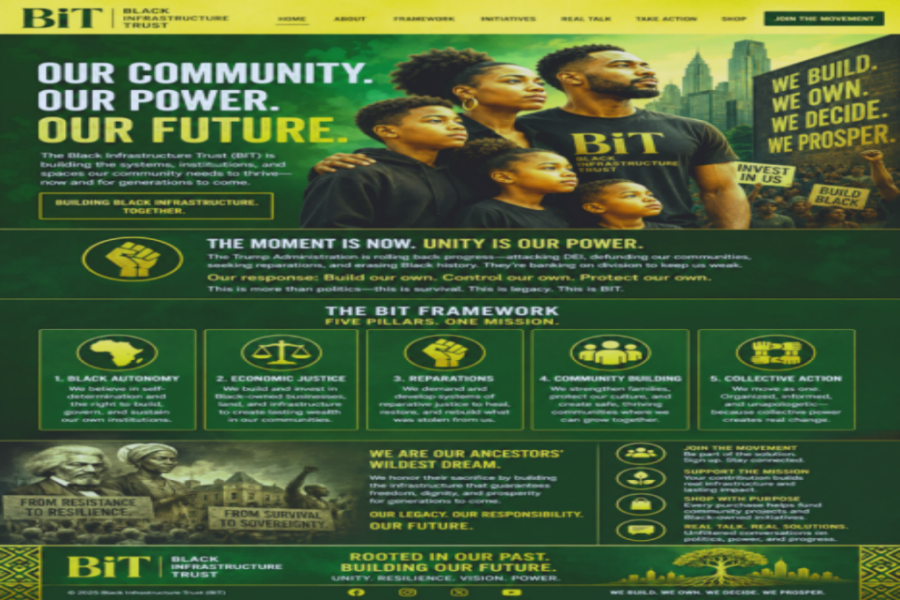
Labor vs. Wealth meetsThe Black Infrastructure Trust Model

Labor vs. Wealth
meets
The Black Infrastructure Trust Model

In all my articles, I give my readers “The Problem” facing the Black community. I do this because I was saddened by all of the posts that highlighted racism, white supremacy, and targeted oppression of our community without any attempt whatsoever to provide a solution. Any solution.
I firmly believe that openly speaking about the harm America has done and continues to do is important. For too many years, we have listened to and were even forced to learned the Mythology of white supremacy in silence. We endured having horrible atrocities done to our ancestors and to us, and being told to ” just get over it” or ” why make everything about race,” or told that our history is not American history. Something separate from what America is. Therefore, I believe that to change, a clear “Solution” should always be included with our lament. Here is the problem.
There are only three ways people gain possibilities in this country:
Education – what you know.
The Economy – what you do.
Elections – who’s in charge.
These lanes should be our path to freedom. But for us, they have always been blocked, narrowed, or stolen.
Education is defunded. The economy is consolidated. Our labor is exploited. Elections are manipulated. Protections we fought for are stripped away.
From the start, these systems were never built for us. They were built for a few. Who set the rules of knowledge, wealth, and power—and decided who could even vote. When we opened the doors, they pushed back. Always contested. Always threatened.
And it’s not just laws—they even attack our culture. They attack our language. They take our words, twist them, and then tell us they’re wrong. Why? Because if they can make our words feel wrong, they can make us feel wrong. If we believe we’ve already lost, we give up before the fight even begins.
Look at D-E-I. Diversity, Equity, Inclusion. Words meant to signal fairness. Words meant to signal justice.
Diversity means we exist. They call it a threat.
Equity means fair access. They call it favoritism.
Inclusion means belonging. They call it weakness.
And then there is woke. Once our word of vigilance. Once our signal to stay awake during Legal Segregation was called Jim Crow. Once our shield against oppression. Now? They stole it, turned it into a joke, an insult. They fear the awake, because an awake people are dangerous to their power.
This is the pattern. Every word that could empower us is first tolerated, then mocked, then weaponized. They want us to abandon our language. But we will not. These words are our truth. They are our survival. They are our claim to wholeness.

“How valuable is your time on earth? Time is the only thing we truly own. The only resource that can’t be replaced. Don’t keep trading your life for crumbs. “
Labor, Wealth, and the Stripped Promise
Labor is an effort of the body. Wealth is the command of vision. Hard work alone does not build freedom. Money obeys thought, not time.
One man digs the hole. Another sells the shovel. Who builds generational wealth?

Showing up every day is not enough. Ownership goes to the one who builds leverage—systems that work long after the shift ends.
For generations, Black people have been forced to sell our hours( our Lives) for another man’s empire, never realizing the law of freedom: money obeys thought, not time.
A man can work his entire life in toil and still be passed by the one who dares to build a system. One man digs a hole, the other owns the company that sells the shovel. Who do you think builds generational wealth?
Our people have been trained to value effort and say, “I worked hard. I showed up every day.” But hard labor alone has never built freedom. The reward goes to those who create leverage—the capacity to multiply effort through organization, ownership, and systems.
That is what Andrew Carnegie and Rockefeller knew: it wasn’t swinging hammers in the mill that made them wealthy; it was building structures that worked while they slept. They built empires.
But what if, instead of empires built on our backs, we built infrastructure for ourselves?
The Solution: The Black Infrastructure Trust
The Black Infrastructure Trust creates the leverage. Just $1 a week multiplied by 20 million Black members can create affordable Childcare centers, Housing, and Medical clinics. Businesses we control. Well-paying employment. Our hours become infrastructure. Time becomes power. Labor becomes wealth. We were trained to trade time for wages. But time is a poor man’s currency. It cannot be reclaimed. Every hour you sell without ownership is gone forever.
Freedom does not come from harder work. Freedom comes from leverage. BIT is that leverage. It turns Black labor into Black infrastructure, Black systems, Black wealth.
Repeat it with me:
We do not trade our lives for crumbs.
We build ownership.
We build freedom.
We build BIT.

From 500 Years of Theft to 500 Years of Wealth

From 500 Years of Theft to 500 Years of Wealth

From Ama Ata Aidoo enters The Black Infrastructure Trust

The Problem Named

In a searing 1987 interview, Ghanaian writer Ama Ata Aidoo looked squarely into the camera and said:

“Since we met you people 500 years ago, look at us, we’ve given everything, and you are still taking. Where would the whole Western world be without Africa — our cocoa, our timber, our gold, our diamonds, our platinum, our whatever. Everything you are is us. And in return for all of this, what have we got? Nothing. Nothing.”

Her words strip away the polite lies of history. For five centuries, Africa and her children have fueled the engines of the West:

  • The Middle Passage carried millions into slavery, generating trillions in stolen labor.
  • Colonialism and extraction stripped the continent of natural resources, enriching Europe and America.
  • Postcolonial systems of debt, trade imbalance, and cultural domination ensured the theft continued.

And what did we receive in return? Not development. Not respect. Not repair. Instead: indoctrination against ourselves, infectious diseases brought across oceans, and a literature that declared us less than human.

Ama Ata Aidoo did not exaggerate. She simply named the truth.

Why Naming Alone Is Not Enough

For generations, we have spoken the truth about our oppression. We have pointed to the theft, to the lies, to the violence of white supremacy. Yet often, that’s where the conversation ends — at lament.

The problem is that naming the wound does not heal the wound. Naming the theft does not stop the theft. If all we do is recite our suffering, the world nods and moves on.

Ama Ata Aidoo gave us the foundation: the problem, in all its brutal clarity. But the question before us is — what comes next?

The Solution: Learning the Playbook

The ultra-rich, the very people who sit atop this system of extraction, pass down to their children a simple wealth-building playbook. It rests on three words: Hold. Borrow. Die.

  • Hold. Buy appreciating assets — stocks, real estate, businesses. Never sell. Wealth compounds quietly, untaxed, across decades.
  • Borrow. Need cash? Don’t sell. Borrow against those assets. Loans aren’t taxed. Liquidity without liability.
  • Die. When they pass away, tax law resets the value. Children inherit wealth with minimal tax. Dynasties are born.

This is not genius. It’s not even secret. It’s simply strategy, repeated generation after generation — and it works because they act collectively within families and financial systems designed to preserve their wealth.

The Black Infrastructure Trust: Collective Wealth-Building

The Black Infrastructure Trust (BIT) exists to take that same playbook and adapt it for us — not as individuals scrambling for survival, but as a people committed to liberation.

Here is how BIT flips “Hold, Borrow, Die” into a collective pathway:

  • Hold Together. BIT acquires land, housing, businesses, and investments on behalf of its members. Instead of wealth slipping through our hands, it is held in trust, appreciating in value, untouched by extraction.
  • Borrow Together. Instead of selling off assets, BIT leverages its holdings to borrow capital. That capital does not disappear into yachts and vanity projects. It funds childcare centers, affordable housing, schools, and medical clinics — infrastructure that directly serves our people.
  • Pass It On Together. Wealth is not drained into private estates or lost at death. It remains within the Trust, preserved and expanded for future generations. Each child born into our community inherits access to this collective legacy.

From Lament to Liberation

Ama Ata Aidoo told us: “Everything you are is us.” She reminded the West that its modern wealth is built on our backs, our land, our resources.

The task before us is to take her indictment and turn it into a blueprint. If everything they are is us, then everything we need to be free is also within us.

The next 500 years cannot look like the last 500. Where our ancestors were forced to give everything and get nothing, we will now hold everything together and build wealth that cannot be stolen.

This is the work of the Black Infrastructure Trust.

We name the wound, yes. But more importantly, we heal it — through ownership, through strategy, through collective power.

If you’re still here, it’s because something real hit you.

But understand this—Real Talk ain’t here to entertain, go viral, or win likes. We don’t move for algorithms—we move for liberation.

So don’t just listen. Reflect. Connect. Build.

I’m not looking for clicks—I’m looking for commitment.

Because the truth is: the time for performative outrage is over, and our window to liberation is closing.

What I’m here to do is connect with the ones ready to move—ready to think differently, build differently, and live free on our own terms. This is about one thing:

Liberation under Black management.

Until the next episode:

Stay sharp. Stay Building. And stay Black on Purpose.

America’s Hypocrisy and the Urgency of Black Infrastructure

The Core Problem

By the plain reading of the Constitution, Confederates who raised arms against the United States were traitors. They were never punished. Traitors reshaped the narrative of their treason, re-casting themselves as “heroes” enshrined in monuments and history books.

That hypocrisy echoes forward: America has always excused treason when it comes draped in whiteness.

Trump Administration & Racial Harm

  • Illegality: Trump was convicted in 2024 on 34 felony counts of falsifying business records; numerous aides and allies have also been convicted or sentenced.
  • Housing: The administration moved to gut HUD’s Affirmatively Furthering Fair Housing rule and weaken the disparate impact standard.
  • Civil Rights Enforcement: Cutbacks in grants and federal enforcement reduced protection against discrimination in housing, employment, and lending.
  • Education: Rolled back federal guidance on racially disparate school discipline, leaving Black students more vulnerable.
  • DEI Suppression: Ordered agencies and contractors to halt anti-racism and implicit bias training.
  • Economics: The Tax Cuts and Jobs Act widened the racial wealth gap.

The Future Without Black-Managed Infrastructure

If this trajectory continues, Black America faces:

  • Housing insecurity and reinforced segregation
  • Widening wealth gaps and blocked access to capital
  • Education setbacks through biased discipline and erased DEI pipelines
  • Weakened civil rights protection, with fewer enforcement avenues
  • Rising bias incidents, legitimized by political rhetoric

The Black Infrastructure Trust (BIT): Our Way Forward

Step 1: The Collective Pool

  • 20 million Black working adults x $1/week = $20 million/week
  • Month 1: $80 million available

That’s startup capital that requires no bank loans, no government grants, no charity.

Step 2: Priority Needs in the Black Community

Childcare is perfect for this because:

  • Black families spend up to 20–25% of their income on childcare.
  • Accessible, affordable childcare directly helps working parents (especially mothers).
  • Centers create stable jobs (educators, cooks, maintenance).
  • It builds community trust—people see where their dollar is going.

Step 3: What $80 Million Buys in Childcare

Costs vary, but here’s a conservative sketch:

  • Startup cost for one mid-sized childcare center: $500,000–$1,000,000 (facility, licensing, staff, equipment).
  • Annual operating budget: $1–2 million (mostly salaries).

👉 With $80 million, BIT could:

  • Open 80–160 childcare centers nationwide in the second month.
  • If focused only on major cities (let’s say the top 50), that’s $1.6M per city, enough to launch and cover first-year operations.

Step 4: The Value Return

Each childcare center:

  • Serves 100–200 children daily.
  • Creates 25–40 jobs per site.
  • Reduces family expenses by $6,000–$12,000/year per child.
  • Reinforces Black ownership of institutions.

So in Month 2, BIT wouldn’t just “open centers”—it would put money back in families’ pockets, employ Black workers, and circulate dollars locally.

If you’re still here, it’s because something real hit you.

But understand this—Real Talk ain’t here to entertain, go viral, or win likes. We don’t move for algorithms—we move for liberation.

So don’t just listen. Reflect. Connect. Build.

I’m not looking for clicks—I’m looking for commitment.

Because the truth is: the time for performative outrage is over.

What I’m here to do is connect with the ones ready to move—ready to think differently, build differently, and live free on our own terms. This is about one thing:

Liberation under Black management.

Until the next episode:

Stay sharp. Stay Building. And stay Black on Purpose.

Land, Brainwashing, and the Blueprint Back to Freedom

The greatest brainwashing done to our people was to turn us away from the land. For centuries, our very survival depended on soil, seeds, and harvest. Land was the foundation of life, the foundation of independence, the foundation of wealth. Enslavers knew this better than anyone. That is why, even as they stole our labor, they made sure that we were taught, to despise the very thing that could free us. When we were forced off land, or when land was taken from us through violence, policy, and fraud, it was more than an economic theft—it was a spiritual disconnection.
But think about it: what built America’s wealth? Cotton. Tobacco. Sugar. Rice. Every crop worked by our ancestors’ hands generated trillions of dollars and launched the United States into the Industrial Revolution. Cotton didn’t just clothe the South—it clothed the world. The global system of capitalism we see today was seeded, watered, and harvested by Black labor on stolen land. Yet after emancipation, we were pushed away from the very source of our power. That was not an accident. That was a strategy.
Here lies the contradiction: we were brainwashed to believe the land meant only slavery, backbreaking work, and poverty. But for our oppressor, the land meant wealth, inheritance, and freedom. They told us to run from it while they locked it up for themselves. That brainwashing is still alive today when young Black people grow up without skills in farming, building, or land management—skills that once defined us. And yet, just as we were turned away, we can turn back.
This is where the Black Infrastructure Trust steps in. BIT flips the brainwashing into a blueprint. We do not return to the land simply for nostalgia—we return to the land as a strategy. BIT acquires land, develops housing, and invests in agriculture not as scattered individuals, but as a collective with the power of pooled resources. With the Trust, we not only grow food, we grow businesses. We not only build homes, we build equity. We not only reconnect with soil, but we also reconnect with power.
Imagine the cycle: BIT members grow produce, BIT-owned facilities process and package it, and BIT-owned stores distribute it back into the community. The same principle applies to housing: we acquire land, build entire developments at cost, and provide housing security to members.
This is the very system denied to us after slavery—production, manufacturing, distribution. That is vertical integration. That is Black liberation through infrastructure.

The deepest contradiction in Black life is expecting our oppressor to participate in
our liberation. For 300 years,
They built wealth from our labor, yet freedom was never part of the deal.

The Black Infrastructure Trust exists because we cannot continue to wait for crumbs—we must build our own systems, for our communities,
with our hands.

The Black Infrastructure Trust acknowledges The only reality: The oppressor will not dismantle the structures they built to exploit us. Instead of waiting for permission,
BIT empowers Black communities to create their own infrastructure, housing, childcare, healthcare,
economic systems—built on our labor, resources, and vision.
Liberation cannot come from those who profit from oppression;
It must come from us.

A Confederate Revival Clothed in Legality

America is in the midst of a counter-revolution. Republican legislatures redraw voting maps mid-decade to hold onto power. The Supreme Court, compromised and partisan, shields these acts from consequence. Lower courts resist here and there, but they are outnumbered, overruled, and overwhelmed. This is not “politics as usual.” It is a Confederate revival clothed in legality.

The South may have lost the Civil War on the battlefield, but it is winning in courtrooms, legislatures, and boardrooms. The Confederacy has learned that you don’t need muskets when you have gerrymanders, voter suppression, and legal fictions to accomplish the same goal: a nation remade in the image of the slaveholding South.

The White House as Color

This hypocrisy is not new. It is America’s original blueprint. The White House—the symbol of democracy itself—was built by enslaved Africans. They quarried the stone, cut the wood, laid the bricks, and crafted the iron. Their skill gave the building its form, but their names were mostly lost because they were considered property.

And even after the White House was completed in 1800, slavery continued inside its walls. Presidents Jefferson, Madison, Monroe, and Jackson all enslaved men, women, and children in the People’s House. The symbol of freedom was built on captivity, then maintained by it. That contradiction is America’s DNA.

Today is no different. The Confederates of our era have traded plantations for courts and overseers for legislators. The pattern is the same: preserve white power, deny Black freedom, call it “law.”

Breaking the Cycle

If America is in its third revolution—one that seeks to restore the Confederacy in spirit—then Black people cannot wait for institutions to save us. We cannot rely on courts or elections to undo what was built to oppress us. We must build something of our own.

That is the purpose of the Black Infrastructure Trust (BIT).

BIT is not a charity program or a temporary fix. It is a system of communal power, built through consistent contributions from its members. Each contribution is a brick in a new house—one not built by slavery but by self-determination.

Consistent Contributions, Collective Power

Here is how it works:

  • Each member contributes regularly to their local Collective.
  • Funds are pooled nationally through BIT, providing the capital necessary to create Black-owned businesses.
  • Each enterprise serves members first, while also offering services to non-members at reduced but still market-sustaining rates.

This is how we create an economy within an economy. One contribution at a time, we build an infrastructure that no legislature can gerrymander away.

The First National Effort: Childcare

Childcare will be the Trust’s first national project. Why? Because childcare is both the anchor of family life and one of the most predatory markets in America. Costs are crushing, and the burden falls hardest on Black families.

Under BIT:

  • Members’ children receive care as part of their contribution.
  • Non-members can access the same care at greatly reduced prices compared to what the market demands.

This model makes childcare affordable, rewards members for consistent investment, and generates revenue to expand the system. Every BIT childcare center is Black-owned, staffed by Black workers paid fairly, and supported by the collective.

Scaling Out: Businesses That Free Us

Childcare is only the beginning. The same model applies to housing, healthcare, food, and financial institutions:

  1. Pool resources.
  2. Build a Black-owned business.
  3. Deliver direct benefit to members, with reduced-price access for non-members.
  4. Recycle revenue into the Trust.

Each enterprise that comes online weakens our dependence on a capitalist system built to exploit us. As BIT expands, members step out of the cycle of overwork and underpay, moving toward communal ownership and freedom.

Communalism as Liberation

This is more than economics. It is a cultural return. Black people have always survived through mutual aid, maroon societies, and cooperative care. BIT is the modern extension of that tradition—a deliberate choice to stop begging for justice from a system that thrives on injustice.

The Confederates are making their move. They are reviving their cause through courts, maps, and laws. Our move must be stronger. Through BIT, we create the infrastructure to step away from their system altogether.

Consistent contributions build businesses. Businesses build freedom. And freedom, once built by us, cannot be taken away.

Liberation under Black management is the only path forward.

Stay Woke (because they’ve demonized it). Stay Building. Stay Black on Purpose.

Because our survival—and our future—depends on it.

The Mythology of Black Fatherlessness

For more than half a century, one of the most insidious lies in American political culture has been the claim that Black men are not fathers to their children. The “absent Black father” trope has circulated in political speeches, media soundbites, and even in the mouths of certain Black elites, who repeat it to curry favor with white institutions. This myth is not harmless. It is a weapon that justifies racist policy, shames Black families, and robs Black men of dignity in the public imagination.

The story goes something like this: Black children fail because Black men have abandoned them. Black communities decline because there are no fathers at home. The solution, then, is not to repair schools, housing, or employment discrimination, but to fix a so-called “culture of irresponsibility.” The genius of this narrative is that it absolves America of its crimes while making Black men the scapegoats.

The Birth of the Lie

The modern version of this myth was institutionalized in 1965 with the publication of The Negro Family: The Case for National Action, better known as the Moynihan Report. Daniel Patrick Moynihan, then a federal bureaucrat, argued that poverty in Black America was caused not by racism or economic exclusion, but by the “tangle of pathology” supposedly rooted in female-headed households. Though he claimed to have sympathetic intentions, the report pathologized Black family structures and made fatherlessness the central explanation for inequality.

What followed was devastating. Policymakers seized on the idea. Welfare reforms in the 1970s and 1980s punished poor Black mothers for living with men in the home, forcing fathers out to maintain eligibility. By the 1990s, “personal responsibility” politics and the rise of mass incarceration created conditions where millions of Black fathers were literally removed from their families by state violence. Then the media stepped in, reinforcing the stereotype with endless headlines about “broken Black families.”

The result: a cultural consensus that Black men are absent, irresponsible, and dangerous—an image that white supremacy requires to rationalize its own brutality.

The Empirical Truth

But the lie collapses under the weight of data. In 2013, the Centers for Disease Control conducted one of the largest studies on fatherhood in America. The findings were explosive:

  • Black fathers were more engaged in daily childcare tasks—such as feeding, bathing, reading, and helping with homework—than white or Hispanic fathers.
  • Even when not living in the same household, Black fathers were more involved with their children than non-cohabiting white or Hispanic fathers.

In other words, even when the deck is stacked against them, Black men show up for their children at higher rates than anyone else. The stereotype of “absent Black fathers” is not only false—it is the opposite of reality.

The problem is not fatherlessness. The problem is America’s refusal to recognize Black men’s fatherhood, and its active investment in erasing that truth.

Reconstructing the Black Man’s Public Image

How, then, do we repair the public image of Black men? Statistics alone cannot undo centuries of propaganda, psychological operations waged against both the Black community in general and Black men specifically.  

We need living counterexamples that operate on a large scale. We need institutions that affirm what our families already know: that Black fathers are present, capable, and indispensable.

This is why the Black Infrastructure Trust (BIT) exists. One of its most transformative initiatives is the Black Men’s Mentorship Group—an institutional answer to the myth.

The Black Men’s Mentorship Group

Every BIT Collective establishes a Mentorship Cell, composed of members committed to guiding the next generation. The program begins at age eight, when boys start asking deeper questions about selfhood and responsibility. Each child of a single mother is paired with a mentor—whether or not the biological father is present. The purpose is not to replace fathers, but to ensure every child has multiple men invested in their growth.

The mentorship is structured, not symbolic. It includes:

  • Life Skills: from cooking and financial literacy to trade exposure and health practices.
  • Decision-Making: teaching frameworks for weighing consequences, solving problems, and exercising leadership.
  • Ethics and Community: grounding boys in accountability, compassion, and a love of community above individualism.

At age fourteen, each mentee faces a pivotal choice: continue in public education or enroll in the exclusive Black Military Academy—a BIT institution that combines rigorous academics with vocational training, trades, and pathways to higher education. The Academy instills discipline, excellence, and the principle that Black labor and intellect exist first to serve Black liberation, not capitalist exploitation.

Value, Labor, and Compensation

Unlike in capitalism, where mentorship would be considered “volunteering,” BIT recognizes it as essential labor. Mentors are compensated with community credits—a parallel currency within the Collective. Credits can be redeemed for housing, food, childcare, healthcare, and other services provided by BIT. Every hour invested in a child is an hour added to the community’s wealth.

This does two things at once: it honors the work of Black men as fathers and guides, and it strengthens the ecosystem of autonomy from capitalism.

The Larger Goal: Autonomy from Capitalism

The fatherhood program is not just about individual boys. It is about restructuring value itself. In capitalist America, Black men are either criminalized or exploited. Their worth is calculated in prison sentences served or profits extracted. Under BIT, worth is measured in contribution to community: in raising children, defending families, and sustaining culture.

The ultimate aim is total autonomy from capitalism. This means:

  • Raising children in ecosystems of care, not dependency on hostile state structures.
  • Building institutions that replace punishment with guidance, exclusion with belonging.
  • Defining value not by dollars earned, but by futures secured.

Conclusion: The End of the Lie

The myth of Black fatherlessness persists because white supremacy cannot survive without it. To admit the truth—that Black men are present, engaged, and essential—would unravel decades of policy, policing, and propaganda.

BIT exists to ensure that the truth not only circulates, but is embodied in living institutions. Every mentorship, every Academy graduate, every child who grows up surrounded by fathers and uncles and mentors, drives a stake into the heart of the lie.

Black men are not absent. We are here. We are raising our children, building our institutions, and leading our people toward autonomy.

The Predatory Housing Playbook

Problem Statement: Housing as a Weapon

For most families, a home is supposed to be more than shelter. It is the anchor of stability, the center of memory, and, in America, the most common way wealth is passed down. But for Black people, housing has always been a battlefield. From redlining and racial covenants to predatory loans and gentrification, the roof over our heads has been manipulated into a tool of dispossession.

Today’s enemy is not just a banker with a red pen or a landlord with a grudge. It is institutional capital itself—private equity firms, hedge funds, and corporate landlords who see neighborhoods not as communities but as spreadsheets. They are not building homes to be lived in. They are extracting wealth from the very ground beneath us.

Exposing the Scam: How Institutional Buyers Rig the Market

Here is how the modern housing hustle works:

  1. Bulk Buying Discounts
  2. A developer builds a subdivision—say, 500 homes. A working family might expect to buy one for $500,000. But an institutional investor comes in and buys all 500 at once, paying only $300,000 per home. Volume gets them a steep discount.
  3. Artificial Scarcity
  4. Instead of filling the homes with families, the investor keeps them empty. The neighborhood sits unfinished, looking like a construction zone. The message is clear: this is not for you.
  5. Self-Dealing to Inflate Comps
  6. A year later, the investor sells three of the homes—but only to themselves, through another fund or LLC they already control. Each sale is booked at $700,000. That’s double what they paid.
  7. Those three sales are now comparables (“comps”), the standard appraisers use to set neighborhood values.
  8. Paper Wealth, Real Exploitation
  9. Suddenly, the entire subdivision is “worth” $700,000 per house. On paper, the investor has doubled their money. They can now rent the homes out at obscene rates because local families no longer qualify for mortgages at those inflated prices. Worse still, the investor can borrow against this inflated portfolio, pulling out cash to buy the next community.
  10. The Fallout
    • Families are priced out of ownership.
    • Renters face skyrocketing costs.
    • Communities are hollowed out, wealth siphoned away.

This is not free-market housing. This is engineered scarcity and price-fixing in plain sight. And it is happening across the country, particularly in Black and working-class neighborhoods where desperation makes people easiest to exploit.

BIT as the Answer: Flipping the Script

The Black Infrastructure Trust (BIT) was created to break this cycle. Where Wall Street sees homes as profit centers, BIT sees them as community foundations. Our strategy is simple: use the same tools of scale and finance, but redirect the gains back into the people.

  1. Collective Buying Power
  2. Instead of 500 homes going to a hedge fund, BIT pools member resources and buys them in bulk. We demand the same discounts institutional investors receive.
  3. Community Comps, Not Inflated Comps
  4. Rather than sell to ourselves at inflated prices, BIT does the opposite: we sell or lease units at affordable rates to our members. That sets a different kind of comp—one that stabilizes neighborhoods instead of pricing people out.
  5. Permanent Affordability
  6. BIT locks housing into cooperative and community land trust structures. That means homes cannot be flipped for profit on the speculative market. They remain affordable, generation after generation.
  7. Reinvestment, Not Extraction
  8. The money families spend on housing stays in the community. Rental revenue funds childcare centers, healthcare clinics, and schools—expanding the safety net rather than shredding it.

Closing: From Exploitation to Liberation

The scam is clear. Housing was weaponized against us through manipulation, speculation, and financial engineering. But it doesn’t have to be this way. With BIT, we flip the playbook. We stop being the prey of outside capital and instead become the stewards of our own neighborhoods.

A home should never be a casino chip. It should be a sanctuary. And BIT exists to make sure it stays that way.

If you came for entertainment or drama, this ain’t that.

This space was built for those who are tired of the hypocrisy and are ready to create solutions.

I’m not looking for followers—I’m looking for those who are committed to Liberation under Black management.

What I’m here to do is connect with like-minded people ready to move—ready to think differently, build differently, and live free on our terms.

This is about one thing:

Liberation under Black management.